
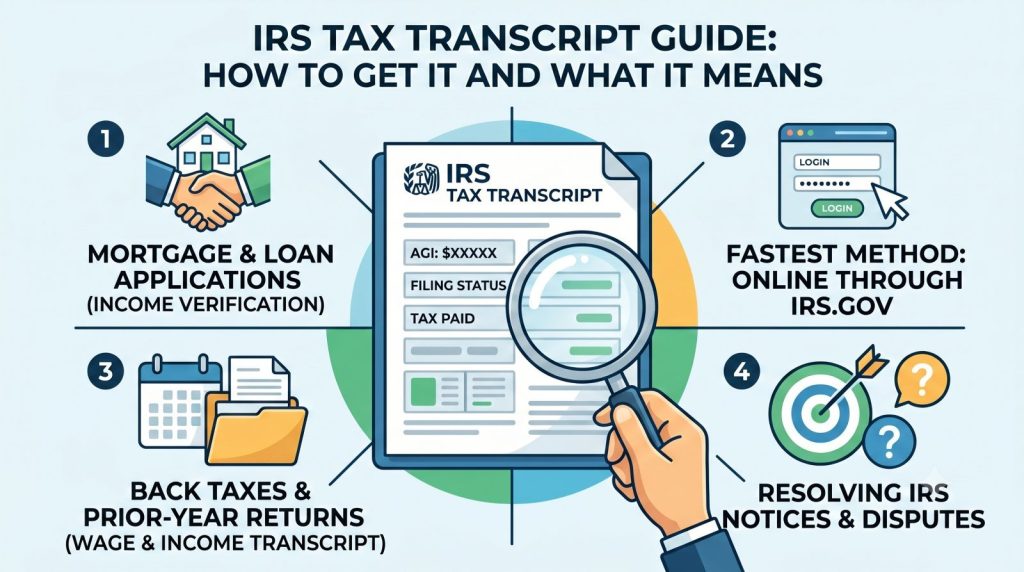
If you’re applying for a mortgage, applying for student financial aid, or trying to resolve an unexpected letter from the government, you will likely hear a common request: “Please provide your IRS tax transcript.”
But what exactly is an IRS tax transcript, how does it differ from a regular tax return, and how can you get one quickly without paying a fee?
Here is a comprehensive breakdown of everything you need to know about navigating your IRS transcripts.
What Is an IRS Tax Transcript?
An IRS tax transcript is a free, official summary of your federal tax return information and your overall IRS account history. While it isn’t a photocopy of your actual tax return, it provides the exact line-item details that banks, institutions, and tax professionals look for to verify your financial standing.
Common Uses for Tax Transcripts:
-
Income Verification: Proving your earnings for mortgage, auto, or personal loan applications.
-
Filing History: Confirming you successfully filed past tax returns.
-
Dispute Resolution: Helping to understand and resolve IRS notices, audits, or discrepancies.
-
Back Taxes: Accessing prior-year data to prepare delinquent or amended tax returns.
-
Tracking History: Verifying estimated tax payments, penalties, or outstanding tax balances.
The 5 Types of IRS Tax Transcripts Explained
The IRS offers five distinct types of transcripts depending on what financial data you or your lender require.
| Transcript Type | What It Shows | Best Used For |
| 1. Tax Return Transcript | Most line items from your original return (AGI, taxable income, filing status, dependents, deductions). Note: Does not show changes made after filing. | Mortgage applications, student loan verification, basic income proof. |
| 2. Tax Account Transcript | Basic account data including tax assessments, payments received, penalties, interest, and post-filing adjustments. | Researching IRS notices, checking payment history, or resolving account issues. |
| 3. Record of Account Transcript | A comprehensive document that combines the Tax Return Transcript and Tax Account Transcript into one file. | Handling complex IRS disputes, audits, or tax amendments. |
| 4. Wage and Income Transcript | Data reported to the IRS by third parties (Forms W-2, 1099, 1098, retirement distributions, and Social Security statements). | Reconstructing a prior-year return if you lost your physical tax documents. |
| 5. Verification of Non-Filing Letter | An official statement confirming that the IRS has no record of a filed tax return for that specific year. | Fulfilling requests from colleges or lenders verifying you weren’t required to file. |
How to Get Your IRS Tax Transcript
The IRS provides transcripts completely free of charge. You can obtain them using two primary methods:
1. Online (Fastest Method)
You can instantly access your Tax Return, Tax Account, Wage and Income, and Record of Account transcripts online.
-
Visit the official IRS.gov website.
-
Log into (or create) your secure IRS online account.
-
Complete the necessary identity verification steps.
-
Once verified, your documents will be available for immediate download.
2. By Mail
If you cannot verify your identity online or prefer physical copies, you can request that the IRS mail your transcript.
-
The IRS will automatically mail the document to the address they currently have on file.
-
Please note: Delivery times fluctuate depending on seasonal IRS processing volumes, so plan ahead if you are facing a strict loan deadline.
How Long Does the IRS Keep Tax Transcripts?
Availability depends heavily on the specific transcript type and your overall account activity:
-
Tax Return Transcripts: Generally available for the current tax year and the prior three years.
-
Wage and Income Transcripts: Often accessible for up to ten years back.
-
Account Information: May remain active and available for even longer periods if there is ongoing collection, payment, or dispute activity on the account.
Frequently Asked Questions (FAQs)
Is a tax transcript the same as a tax return?
No. A tax return is the actual form (like Form 1040) you or your preparer filled out. A tax transcript is an IRS-generated summary of that form and any subsequent account changes.
Are IRS tax transcripts free?
Yes. The IRS never charges a fee to access or mail your tax transcripts. Be cautious of third-party websites trying to charge you for this data.
Can I use a transcript instead of a tax return?
In most cases, yes. Most modern lenders, banks, and government agencies actually prefer transcripts because they come directly from the IRS database, reducing the risk of fraud.
Can a transcript show if my refund was issued?
Yes. If you pull a Tax Account Transcript, it will explicitly list line items tracking your refund status, issuance dates, and payment activity.
Final Thoughts
Knowing how to access your IRS tax transcripts is an essential financial literacy tool. Whether you are buying a home, sorting out back taxes, or simply keeping an eye on your account history, getting the right document online can save you weeks of stress.
To keep your personal information secure, always ensure you are accessing your portal directly through official IRS.gov links.