
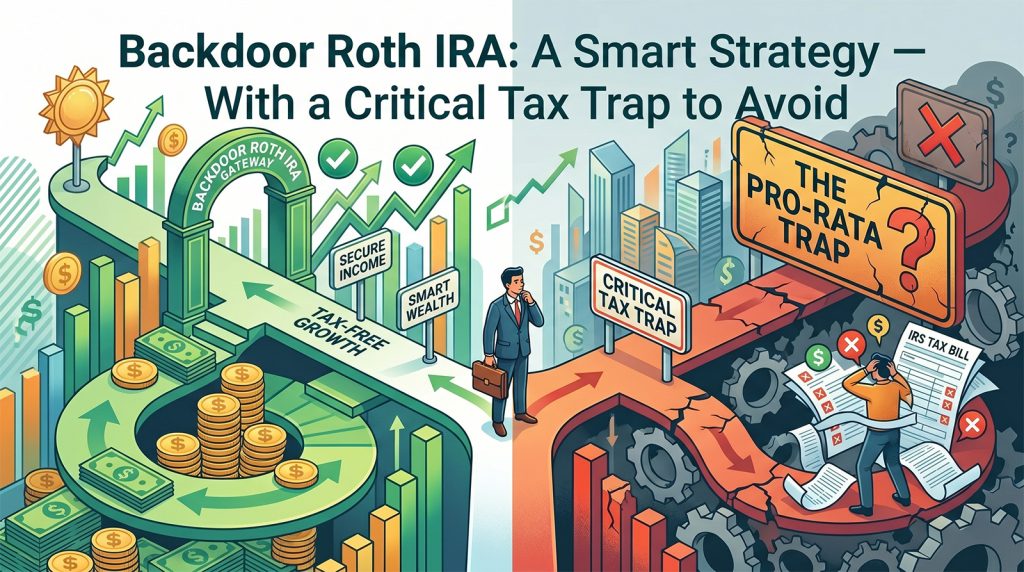
For high-income taxpayers, contributing directly to a Roth IRA is often prohibited by IRS income limits. However, the Backdoor Roth IRA strategy remains a legal and effective workaround to access tax-free growth.
While the strategy is simple in theory, a specific IRS regulation known as the pro-rata rule can turn a tax-free conversion into a surprise tax bill. Here is everything you need to know to execute this move safely.
What is a Backdoor Roth IRA?
A Backdoor Roth IRA is not a specific type of account, but a two-step financial maneuver:
-
Contribute: You make a non-deductible contribution to a Traditional IRA.
-
Convert: You convert those funds into a Roth IRA shortly thereafter.
Because there are no income limits on conversions, this allows high earners to bypass the limits placed on direct contributions.
Benefits of the Backdoor Strategy
-
Tax-Free Growth: Your investments grow without a haircut from Uncle Sam.
-
Tax-Free Withdrawals: Qualified distributions in retirement are 100% tax-exempt.
-
No RMDs: Unlike Traditional IRAs, Roth IRAs do not require minimum distributions during your lifetime.
-
Tax Diversification: Provides a “tax-free” bucket to balance out taxable 401(k) or Social Security income.
The “Pro-Rata Rule” Tax Trap
The most common mistake investors make is assuming they can choose to convert only their new, after-tax money. The IRS, however, views all your Traditional, SEP, and SIMPLE IRAs as a single combined pie.
Under the pro-rata rule, if you have existing pre-tax IRA funds, the IRS requires you to convert a proportional mix of pre-tax and after-tax dollars.
The Pro-Rata Calculation in Action
Imagine you want to convert $10,000, but you already have a large Traditional IRA balance:
-
Existing Traditional IRA (Pre-tax): $90,000
-
New Non-Deductible Contribution: $10,000
-
Total IRA Balance: $100,000
In this scenario, your after-tax “basis” is only 10% of your total IRA holdings. Therefore, only 10% of your conversion will be tax-free. The other 90% ($9,000) will be added to your taxable income for the year.
How to Avoid the Pro-Rata Rule
If you have significant pre-tax IRA balances, you aren’t necessarily stuck. Here are three ways to clear the path for a clean conversion:
1. The 401(k) “Reverse Rollover”
Most employer-sponsored 401(k) plans allow you to roll pre-tax IRA funds into the plan. Since 401(k) balances are not included in the pro-rata calculation, this “hides” your pre-tax money from the IRS during the conversion process.
2. The Total Conversion
If your IRA balance is relatively small, you might choose to convert the entire amount to a Roth IRA. You will pay taxes on the pre-tax portion now, but you’ll never pay taxes on that money (or its growth) again.
3. Start with a Zero Balance
The strategy is cleanest for those with no existing IRA balances. If you only have a 401(k) and no IRAs, you can execute the Backdoor Roth annually with zero tax friction.
Essential Compliance: Timing and Reporting
Does Timing Matter?
While there is no “official” waiting period required by the IRS between contribution and conversion, many advisors suggest waiting at least one statement cycle. The goal is to convert the funds before they earn significant interest, as any gains earned while the money is in the Traditional IRA will be taxable upon conversion.
IRS Form 8606
To avoid being taxed twice, you must file IRS Form 8606 with your tax return. This form tracks your “basis” (the after-tax money) in your IRAs. If you don’t file it, the IRS may assume all the money you converted was pre-tax and send you a bill.
The Bottom Line
The Backdoor Roth IRA is a premier tool for high-income earners, but the IRS aggregation rules make it a potential minefield. Before moving funds, audit your existing IRA accounts to ensure you aren’t walking into a pro-rata trap.