
Individual Retirement Accounts (IRAs) offer substantial tax advantages, but navigating IRS transfer and distribution regulations requires extreme precision. While minor administrative errors like excess contributions or missed Required Minimum Distributions (RMDs) often have IRS relief mechanisms or penalty waivers, certain rollover and distribution mistakes are permanent.
Executing an invalid transaction can trigger immediate income tax liabilities, non-refundable 10% early-withdrawal penalties, and an irreversible loss of tax-advantaged compound growth.
At a Glance: 4 High-Risk IRA Mistakes
| IRA Mistake | The Underlying Rule | The Consequence | The Solution |
|---|---|---|---|
| 1. Cashing Out an Inherited IRA (Non-Spouse) | Non-spouse beneficiaries cannot execute 60-day indirect rollovers. | 100% of the distribution becomes immediately taxable income. | Direct trustee-to-trustee transfer into a properly titled Inherited IRA. |
| 2. Breaking the 1-Rollover-Per-Year Rule | Only one 60-day indirect IRA-to-IRA rollover is permitted across all accounts in a 12-month period. | Subsequent rollovers are disqualified: income taxes, 10% penalty, and excess contribution excise taxes. | Use unlimited direct custodian-to-custodian transfers. |
| 3. Modifying a Section 72(t) SEPP Plan | Payments must remain unchanged for 5 years or until age 59½, whichever is later. | Retroactive 10% penalty on all prior distributions, plus statutory interest. | Lock the payment schedule; isolate SEPP funds in a standalone IRA. |
| 4. Violating the “Same-Property” Rule | Indirect rollovers of non-cash property (stocks/bonds) require redepositing the exact same assets. | Selling distributed shares and depositing cash invalidates the rollover, triggering full taxation. | Transfer in-kind or sell assets inside the IRA before requesting a direct transfer. |
1. Taking Possession of an Inherited IRA Distribution as a Non-Spouse Beneficiary
When inheriting an IRA, non-spouse beneficiaries face vastly different regulations than surviving spouses:
- Surviving Spouses: Can treat the account as their own, roll the assets into their existing IRA, or utilize the standard 60-day rollover window.
- Non-Spouse Beneficiaries: Are strictly prohibited from completing a 60-day indirect rollover.
If a non-spouse beneficiary accepts a check payable directly to themselves—even with the intent of depositing it into an Inherited IRA within 60 days—the IRS treats the entire distribution as a completed, taxable event. That money can never be returned to a retirement vehicle, accelerating tax liability and often pushing the beneficiary into a significantly higher federal income tax bracket.
How to Avoid It:
Never request or accept a check made out in your name. Require a direct trustee-to-trustee transfer. Ensure the receiving account is titled correctly under IRS naming conventions (e.g., “John Doe, deceased, for the benefit of Jane Doe, Beneficiary”). If a check is issued, it must be made payable directly to the receiving custodian for your benefit, not to you personally.
2. Violating the One-Rollover-Per-Year Rule
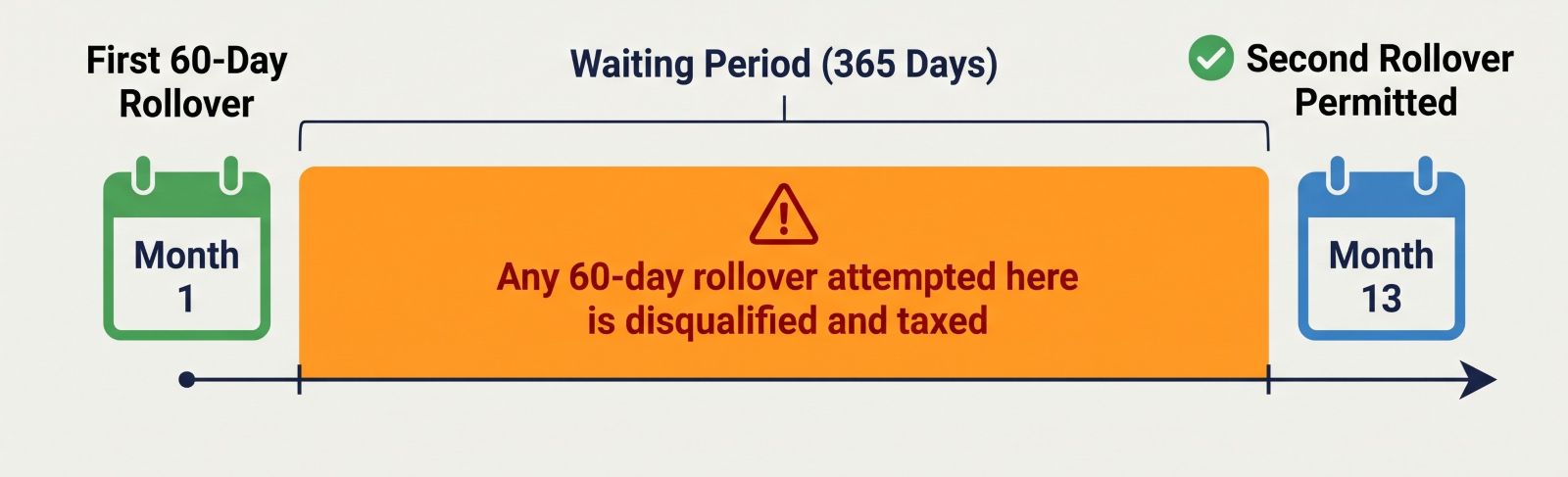
Under Internal Revenue Code Section 408(d)(3)(B), taxpayers are restricted to one indirect, 60-day IRA-to-IRA rollover within a 12-month period:
- A Rolling 12-Month Clock: The window does not reset on January 1; it runs for 365 consecutive days from the date you receive the distribution.
- Aggregate Account Limit: The rule applies across all Traditional and Roth IRAs owned by an individual, not per account.
If you execute a second indirect rollover within 12 months, the second transaction is completely disqualified. The withdrawn balance is treated as a taxable distribution, subjected to a 10% early-withdrawal penalty if you are under age 59½, and treated as an improper contribution in the receiving account (subject to a recurring 6% annual excise tax until corrected).
How to Avoid It:
Bypass indirect rollovers entirely. The one-rollover-per-year limitation does not apply to direct trustee-to-trustee transfers (where money moves institution-to-institution without you touching the funds) nor to rollovers between employer-sponsored plans (like a 401(k)) and IRAs.
3. Modifying a Section 72(t) SEPP Early-Withdrawal Schedule
Section 72(t) provides an exception to the standard 10% early-withdrawal penalty for account owners under age 59½ by establishing a series of Substantially Equal Periodic Payments (SEPP).
While a SEPP arrangement provides structured liquidity before retirement age, it carries rigid operational restrictions:
- Duration Requirement: The exact payment schedule must be maintained without modification for five full years or until you reach age 59½, whichever is later.
- Unauthorized Changes: Any deviation—such as altering the annual withdrawal amount, taking an unscheduled distribution, or contributing additional capital to the account—busts the arrangement.
If a SEPP plan is busted, the IRS retroactively revokes the penalty exemption. You become liable for the 10% early-distribution penalty on every dollar withdrawn across all previous years of the plan, alongside accrued IRS interest.
How to Avoid It:
Segregate the exact assets needed for your SEPP schedule into a separate, dedicated IRA before initiating the plan, leaving other retirement funds unencumbered. Never alter payments or introduce new contributions until your specific 5-year or age-59½ milestone has officially elapsed.
4. Violating the “Same-Property” Rollover Requirement
When completing a 60-day indirect rollover involving non-cash assets (such as individual stocks, bonds, or mutual funds), the IRS enforces a strict “same-property” rule under IRC Section 408(d)(3)(A)(i).
Taxpayers must redeposit the identical property that was distributed:
- If you withdraw 100 shares of stock from an IRA, you must redeposit those exact 100 shares into the receiving IRA.
- You cannot sell the shares while in possession of them and deposit the cash proceeds.
- You cannot sell the distributed shares, purchase shares of another company, and deposit the new securities.
Liquidating or changing distributed assets during an indirect rollover permanently disqualifies the transaction, generating taxable income and potential early-withdrawal penalties.
How to Avoid It:
If you need to reallocate or rebalance portfolio holdings, execute trades inside the IRA shelter prior to initiating any transfer. Alternatively, initiate an in-kind direct trustee transfer between custodians to keep the underlying assets safely within tax-advantaged custody throughout the entire transition.
The Core Strategy: Direct Transfers Over Indirect Rollovers
Most catastrophic IRA errors stem from taking personal receipt of retirement funds. By defaulting to direct trustee-to-trustee transfers, maintaining isolated accounts for specialized strategies like SEPPs, and validating account titling prior to transfer, you shield your retirement savings from accidental distributions and irreversible tax penalties.