
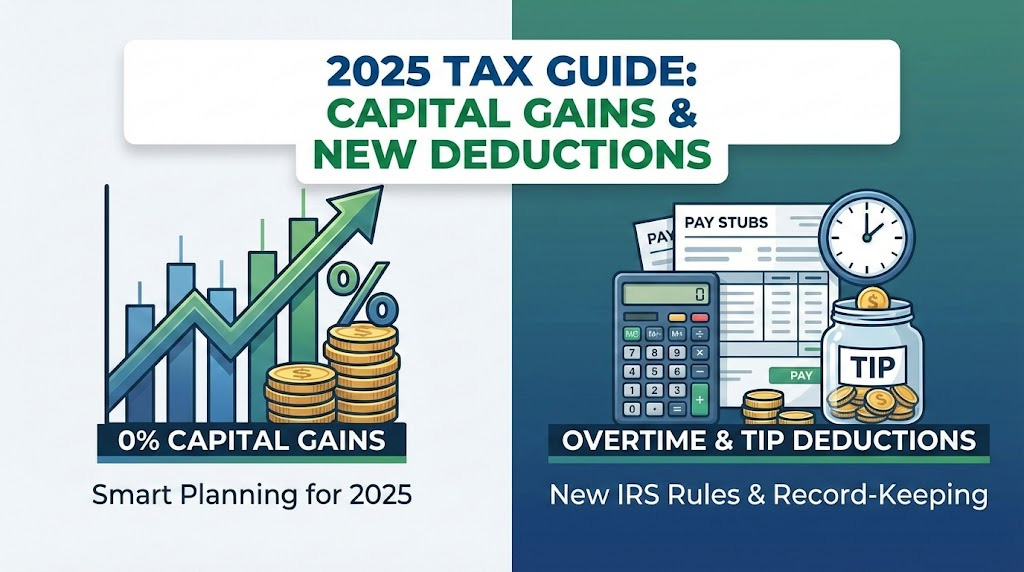
Tax planning for 2025 is shaping up to be a year of significant opportunity and increased complexity. From a “golden window” for 0% capital gains tax to brand-new deductions for hourly and tipped workers, understanding the rules early is critical.
This guide covers the two biggest changes affecting your wallet in 2025:
-
Capital Gains: How to earn over $100k and pay 0% tax on investment sales.
-
New Deductions: Navigating the “One Big Beautiful Bill Act” rules for overtime and tips.
Part 1: How to Qualify for the 0% Capital Gains Tax Rate in 2025
If you plan to sell investments in 2025, you may be able to pay $0 in capital gains tax—even if you make a six-figure income. The secret lies in understanding the difference between your gross income and your taxable income.
2025 Capital Gains Income Thresholds
For the 2025 tax year, you qualify for the 0% long-term capital gains rate if your taxable income falls below these thresholds:
- Single Filers:
- Taxable Income Limit for 0%: Up to $48,350
- Standard Deduction (2025): $15,000
- Married Filing Jointly:
- Taxable Income Limit for 0%: Up to $96,700
- Standard Deduction (2025): $30,000
The $100K Loophole: Gross vs. Taxable Income
Many investors mistakenly believe they make “too much money” for this break. However, the IRS looks at your taxable income after deductions.
Here is the math: Because the standard deduction is increasing in 2025 ($15,000 for singles; $30,000 for married couples), you can earn significantly more than the threshold and still pay zero tax on your gains.
Example: A married couple earns $125,000 in gross income.
Subtract the $30,000 standard deduction.
Taxable Income: $95,000.
Result: They are below the $96,700 limit and eligible for the 0% capital gains rate.
Strategy: Tax Gain Harvesting
If you fall into this bracket, 2025 is a prime time for Tax Gain Harvesting—selling profitable assets to reset their cost basis without incurring a tax bill.
-
Warning: Capital gains realized count toward your taxable income. A large sale could push you out of the 0% bracket. Always run a full-year tax projection before selling.
Part 2: New IRS Deductions for Overtime & Tips (2025 Rules)
Under the One Big Beautiful Bill Act, new deductions for overtime and tip income take effect for the 2025 tax year. However, the IRS has signaled that 2025 will be a “transition year,” placing the burden of proof squarely on the taxpayer.
The 2025 Overtime Deduction Explained
For 2025, employers are not required to separate qualifying overtime premiums on pay stubs. This means you must calculate your own “qualified overtime compensation” to claim the deduction.
How to Calculate the Overtime Premium
The deduction applies only to the overtime premium, not your total overtime pay.
-
The Formula: You can deduct the “extra” portion of your hourly rate, not the base pay.
-
Example: You earn $10/hour regular pay and $15/hour for overtime.
-
Total Overtime Pay: $15/hour.
-
Deductible Amount: Only the $5/hour premium.
-
If your pay stub lumps overtime into one total, the IRS suggests dividing the total by three (for time-and-a-half) or four (for double-time) to isolate the premium.
Deduction Limits & Phaseouts
-
Single Filers: Capped at $12,500. (Phases out above $150k).
-
Married Filing Jointly: Capped at $25,000. (Phases out above $300k).
-
Exclusions: Salaried professionals, executives, and commission-based salespeople generally cannot claim this deduction.
The New Tip Income Deduction
Workers in nearly 70 tip-heavy occupations (e.g., bartenders, taxi drivers, caddies) can deduct qualifying tips. Like the overtime rule, documentation is key.
What Qualifies?
-
Voluntary Tips: Cash or credit tips left freely by customers.
-
Non-Qualifying: Mandatory service charges (e.g., automatic 18% gratuity) do not qualify.
Reporting Restrictions:
-
Cap: $25,000 per tax return (not per person).
-
Gig Workers: If you receive a Form 1099-K, it likely won’t separate tips. You must keep a daily log to prove which amounts were voluntary tips.
Essential Action Steps for Taxpayers
To claim these benefits, you will need to file the new Schedule 1-A in early 2026. Because employer reporting will be incomplete for 2025, you must start keeping records immediately.
Your 2025 Document Checklist:
-
Save Every Pay Stub: Do not rely on the year-end W-2; it may not show the breakdown you need.
-
Log Overtime Hours: Track the specific dates and hours worked at overtime rates.
-
Separate Tips from Fees: Keep a daily tip log, especially if you are a gig worker.
-
Verify W-2s: Ensure your personal records align with year-end summaries.
Summary
The 2025 tax year offers unique chances to save—whether through the 0% capital gains bracket or new labor deductions. However, the complexity of Schedule 1-A and the lack of employer reporting requirements mean that poor record-keeping could lead to lost refunds or IRS audits. Start tracking your income sources now to ensure a smooth filing season.